Showing posts with label Arip Nurahman. Show all posts

Thursday, December 20, 2012

Keajaiban Dunia ELEKTRON Yang Menakjubkan

The electron (symbol: e−) is a subatomic particle with a negative elementary electric charge.


An electron has no known components or substructure. It is generally thought to be an elementary particle.An electron has a mass that is approximately 1/1836 that of the proton.The intrinsic angular momentum (spin) of the electron is a half-integer value in units of ħ, which means that it is a fermion. The antiparticle of the electron is called the positron; it is identical to the electron except that it carries electrical and other charges of the opposite sign. When an electron collides with a positron, both particles may be totally annihilated, producing gamma ray photons.

Electrons, which belong to the first generation of the lepton particle family, participate in gravitational, electromagnetic and weak interactions. Like all matter, they have quantum mechanical properties of both particles and waves, so they can collide with other particles and can be diffracted like light. However, this duality is best demonstrated in experiments with electrons, due to their tiny mass. Since an electron is a fermion, no two electrons can occupy the same quantum state, in accordance with the Pauli exclusion principle.

Symbol e−, β−
Antiparticle Positron (also called antielectron)
Theorized Richard Laming (1838–1851),
G. Johnstone Stoney (1874) and others.
Discovered J. J. Thomson (1897)
Mass 9.10938291(40)×10−31 kg
5.4857990946(22)×10−4 u
[1,822.8884845(14)]−1 u
0.510998928(11) MeV/c2
Electric charge −1 e
−1.602176565(35)×10−19 C
−4.80320451(10)×10−10 esu
Magnetic moment −1.00115965218076(27) μB
Spin 1⁄2


Electrons may be created through beta decay of radioactive isotopes and in high-energy collisions, for instance when cosmic rays enter the atmosphere. Electrons may be destroyed through annihilation with positrons, and may be absorbed during nucleosynthesis in stars. Laboratory instruments are capable of containing and observing individual electrons as well as electron plasma, whereas dedicated telescopes can detect electron plasma in outer space. Electrons have many applications, including in electronics, welding, cathode ray tubes, electron microscopes, radiation therapy, lasers, gaseous ionization detectors and particle accelerators.

Memahami Elektron

Sebuah atom, terlalu kecil untuk dilihat dengan mata telanjang, terdiri dari inti dan elektron yang berputar di sekitar inti. Proton merupakan inti bermuatan positif dan neutron tidak bermuatan, inti itu sendiri selalu bermuatan positif. Sedangkan elektron yang berputar di sekitar inti sebanyak satu juta kali putaran per detik SELALU bermuatan negatif.

Salah satu karakteristik terpenting yang membuat atom begitu menakjubkan adalah putaran dari electron yang tanpa henti. Elektron dalam atom, yang tidak pernah berhenti berputar sejak saat penciptaan mereka, TERUS BERPUTAR TANPA TERPUTUS DENGAN KECEPATAN YANG SAMA, tidak peduli berapa banyak waktu berlalu atau dari bagian apa substansi mereka.

Setiap atom memiliki jumlah elektron yang berbeda. Misalnya, hanya ada 1 elektron dalam atom hidrogen, 2 elektron dalam atom helium dan 92 elektron dalam atom uranium. Elektron-elektron tersebut berputar pada tujuh orbit yang terpisah. Dalam atom yang berat, sekitar 100 elektron didistribusikan di antara tujuh orbit tersebut. Sejumlah elektron berputar dengan kecepatan luar biasa pada orbit yang sama, atau bahkan ada elektron yang menyeberang antar orbit. 

TETAPI MEREKA TIDAK PERNAH bertabrakan. Hal Ini adalah salah satu aspek yang paling menakjubkan dari elektron. Tak ada satupun dari seratus atau lebih elektron pada tujuh orbit berbeda, yang berputar satu juta kali tiap detiknya, yang pernah bertabrakan dengan elektron yang lain, berhenti berputar atau putarannya menjadi lambat. Setiap elektron masing-masing mengontrol gerakannya yang menakjubkan itu agar tetap pada jalannya sendiri, dalam harmoni yang menakjubkan, dan telah melakukannya sejak penciptaan alam semesta.

Wallohualam Bissawab

Sumber:

1. Wikipedia
2. Harun Yahya

Thursday, December 1, 2011

Reaktor Fusi

Reaktor Fusi
Diagnostics


About 50 individual measurement systems will help to control, evaluate and optimize plasma performance in ITER and to further understanding of plasma physics.


An extensive diagnostic system will be installed on the ITER machine to provide the measurements necessary to control, evaluate and optimize plasma performance in ITER and to further the understanding of plasma physics. These include measurements of temperature, density, impurity concentration, and particle and energy confinement times.


A Bolometer Camera developed at JET. Photo courtesy:K McKormick (IPP,Garching), A Huber (FZK)
The system will comprise about 50 individual measuring systems drawn from the full range of modern plasma diagnostic techniques, including lasers, X-rays, neutron cameras, impurity monitors, particle spectrometres, radiation bolometers, pressure and gas analysis, and optical fibres.


Because of the harsh environment inside the Vacuum Vessel, these systems will have to cope with a range of phenomena not previously encountered in diagnostic implementation, while all the while performing with great accuracy and precision. The levels of neutral particle flux, neutron flux and fluence will be respectively about 5, 10 and 10,000 times higher than the harshest experienced in today's machines. The pulse length of the fusion reaction - or the amount of time the reaction is sustained - will be about 100 times longer.

Thursday, November 3, 2011

Reaktor Fusi

Reaktor Fusi

Vacuum Vessel


The large stainless steel Vacuum Vessel provides an enclosed, vacuum environment for the fusion reaction.


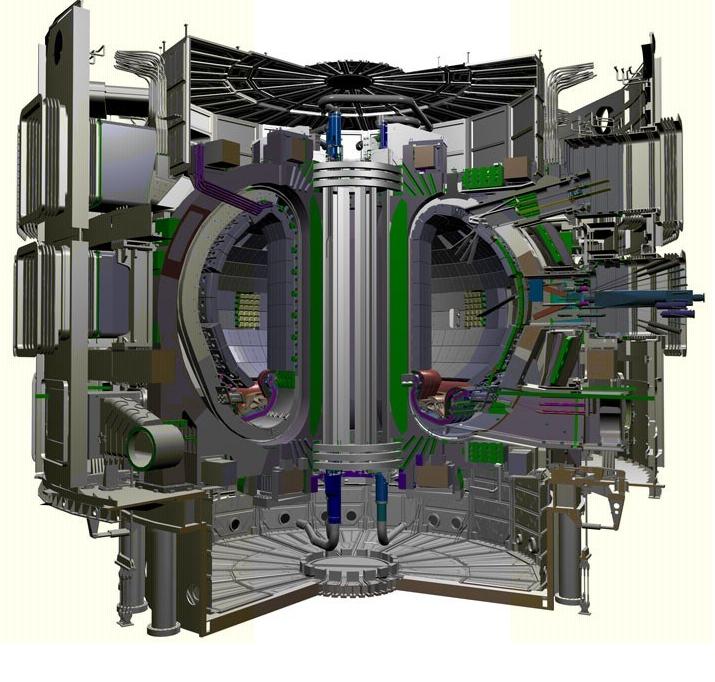
A cut-away of the ITER Vacuum Vessel showing the Blanket modules attached to its inner wall and the Divertor at the bottom.
The Vacuum Vessel is a hermetically-sealed steel container inside the Cryostat that houses the fusion reaction and acts as a first safety containment barrier. In its doughnut-shaped chamber, or torus, the plasma particles spiral around continuously without touching the walls.


The size of the Vacuum Vessel dictates the volume of the fusion plasma; the larger the vessel, the greater the amount of power that can be produced. The ITER Vacuum Vessel will be twice as large and sixteen times as heavy as any previous tokamak, with an internal diametre of 6 metres. It will measure a little over 19 metres across by 11 metres high, and weigh in excess of 5000 tons.


The ITER Vacuum Vessel with its 44 ports. At 8000 tons, the stainless steel vacuum vessel weighs slightly more than the Eiffel Tower.


The Vacuum Vessel will


have double steel walls, with passages for Cooling Water to circulate between them. The inner surfaces of the Vessel will be covered with Blanket Modules that will provide shielding from the high-energy neutrons produced by the fusion reactions. Some of the Blanket Modules will also be used at later stages to test materials for Tritium Breeding concepts.


Forty-four ports will provide access to the Vacuum Vessel for Remote Handling operations, Diagnostic systems, Heating, and Vacuum systems: 18 upper ports, 17 equatorial ports, and 9 lower ports.
Sumber:
Web Resmi ITER

Sunday, October 2, 2011

Reaktor Fusi

Reaktor Fusi

Magnets


The 48 elements of the ITER Magnet system will generate a magnetic field some 200 000 times higher than that of our Earth.


The ITER Magnet System comprises 18 superconducting Toroidal Field and 6 Poloidal Field coils, a Central Solenoid, and a set of Correction coils that magnetically confine, shape and control the plasma inside the Vacuum Vessel. Additional coils will be implemented to mitigate Edge Localized Modes (ELMs), which are highly energetic outbursts near the plasma edge that, if left uncontrolled, cause the plasma to lose part of its energy.


Superconducting cable being spooled after production at ASIPP, Institute for Plasma Physics, Hefei, China. Photo: Peter Ginter
The power of the magnetic fields required to confine the plasma in the ITER Vacuum Vessel is extreme. For maximum efficiency and to limit energy consumption, ITER uses superconducting magnets that lose their resistance when cooled down to very low temperatures. The Toroidal and Poloidal Field coils lie between the Vacuum Vessel and the Cryostat, where they are cooled and shielded from the heat generating neutrons of the fusion reaction.


The superconducting material for both the Central Solenoid and the Toroidal Field coils is designed to achieve operation at high magnetic field (13 Tesla), and is a special alloy made of Niobium and Tin (Nb3Sn). The Poloidal Field coils and the Correction coils use a different, Niobium-Titanium (NbTi) alloy. In order to achieve superconductivity, all coils are cooled with supercritical Helium in the range of 4 Kelvin (-269°C). Superconductivity offers an attractive ratio of power consumption to cost for the long plasma pulses envisaged for the ITER machine.
Toroidal Field System


One of the 18 Toroidal Field coils.
The 18 Toroidal Field (TF) magnets produce a magnetic field around the torus, whose primary function is to confine the plasma particles. The ITER TF coils are designed to have a total magnetic energy of 41 gigajoules and a maximum magnetic field of 11.8 tesla. The coils will weigh 6540 tons total; besides the Vacuum Vessel, they are the biggest components of the ITER machine.


The coils will be made of Cable-In-Conduit superconductors, in which a bundle of superconducting strands is cabled together and cooled by flowing Helium, and contained in a structural jacket. The strands necessary for the ITER TF coils have a total length of 150.000 kilometres and would span the earth more than three times.
Poloidal Field System


The Poloidal Field coil system consists of six independent coils placed outside the Toroidal Magnet structure.
The Poloidal Field (PF) magnets pinch the plasma away from the walls and contribute in this way to maintaining the plasma's shape and stability. The PF field is induced both by the Magnets and by the current drive in the plasma itself.


The Poloidal Field coil system consists of six horizontal coils placed outside the Toroidal Magnet structure. Due to their size, the actual winding of five of the six PF coils will take place in a dedicated, 250-metre long coil winding building on the ITER site in Cadarache. The smallest of the PF coils will be manufactured offsite and delivered finished.


The ITER PF coils are also made of Cable-in-Conduit conductors. Two different types of strands are used according to operating requirements, each displaying differences in high-current and high-temperature behaviour.
Central Solenoid


The Central Solenoid - the backbone of the Magnet system - is essentially a large transformer.
The main plasma current is induced by the changing current in the Central Solenoid which is essentially a large transformer, and the 'backbone' of the Magnet System. It contributes to the inductive flux that drives the plasma, to the shaping of the field lines in the Divertor region, and to vertical stability control. The Central Solenoid is made of six independent coil packs that use a Niobium-Tin (Nb3Sn) Cable-in-Conduit superconducting conductor, held together by a vertical precompression structure. This design enables ITER to access a wide operating window of plasma parameters, enabling the testing of different operating scenarios up to 17 MA and covering inductive and non-inductive operation.


Each coil is based on a stack of multiple pancake winding units that minimizes joints. A glass-polyimide electrical insulation, impregnated with epoxy resin, gives a high voltage operating capability, tested up to 29 kV. The conductor jacket material has to resist the large electromagnetic forces arising during operation and be able to demonstrate good fatigue behaviour. The conductor will be produced in unit lengths up to 910 metres.

Sumber:
Web Resmi ITER

Thursday, September 1, 2011

Reaktor Fusi

Reaktor Fusi
Cryostat


The entire Vacuum Vessel is enclosed within a Cryostat, or cold box, which provides insulation for the superconducting Magnet system and other components.


The ITER Cryostat will be 31 metres tall and nearly 37 metres wide.
The Cryostat is a large, stainless steel structure surrounding the Vacuum Vessel and superconducting Magnets, providing a super-cool, vacuum environment. It is made up of two concentric walls connected by horizontal and vertical ribs. The space between the walls is filled with Helium gas at slightly above one atmosphere that acts as thermal barrier. The Cryostat is 31 metres tall and 36.5 metres wide.


The Cryostat has many openings, some as large as four metres in diametre, which provide access to the Vacuum Vessel for Cooling systems, Magnet feeders, auxiliary Heating, Diagnostics, and the removal of Blanket and Divertor parts. Large bellows are used between the Cryostat and the Vacuum Vessel to allow for thermal contraction and expansion in the structures. The Cryostat is completely surrounded by a concrete layer known as the bioshield. Above the Cryostat, the bioshield is two metres thick.

Sumber:

Web Resmi ITER  

Friday, October 1, 2010

Reaktor Fusi

Reaktor Fusi


External Heating Systems


The ITER Tokamak will rely on three sources of external heating to bring the plasma to the temperature necessary for fusion.


The temperatures inside the ITER Tokamak must reach 150 million° Celsius — or ten times the temperature at the core of the Sun — in order for the gas in the vacuum chamber to reach the plasma state and for the fusion reaction to occur. The hot plasma must then be sustained at these extreme temperatures in a controlled way in order to extract energy.


A Neutral Beam Injector and two types of high-frequency electromagnetic waves will help bring the plasma to temperatures exceeding 150 million°C.
The ITER Tokamak will rely on three sources of external heating that work in concert to provide the input heating power of 50 MW required to bring the plasma to the temperature necessary for fusion. These are neutral beam injection and two sources of high-frequency electromagnetic waves.


Ultimately, researchers hope to achieve a "burning plasma" — one in which the energy of the Helium nuclei produced by the fusion reaction is enough to maintain the temperature of the plasma. The external heating can then be strongly reduced or switched off altogether. A burning plasma in which at least 50 percent of the energy needed to drive the fusion reaction is generated internally is an essential step to reaching the goal of fusion power generation.
Neutral Beam Injection


Using injection to heat the fuel in the ITER Tokamak is very much like using steam in the household cappuccino machine to heat milk. Neutral Beam Injectors are used to shoot uncharged high-energy particles into the plasma where, by way of collision, they transfer their energy to the plasma particles.


Before injection, Deuterium atoms must be accelerated outside of the Tokamak to a kinetic energy of 1 Mega electron Volt (MeV). Only atoms with a positive or a negative charge can be accelerated by electric field; for this, electrons must be removed from neutral atoms to create a positively-charged ion. The process must then be reversed before injection into the fusion plasma; otherwise the electrically-charged ion would be deflected by the magnetic field of the plasma cage. In Neutral Beam Injection systems, the ions pass through a cell containing gas where they recover their missing electron and can be injected as fast neutrals into the plasma.


It's all about kinetic energy - the Neutral Beam Injector accelerates fast neutralized Deuterium particles into the plasma.
The large plasma volume at ITER will impose new requirements on this proven method of injection: the particles will have to move three to four times faster than in previous systems in order to penetrate far enough into the plasma, and at these higher rates the positively-charged ions become difficult to neutralize. At ITER, for the first time, a negatively-charged ion source has been selected to circumvent this problem. Although the negative ions will be easier to neutralize, they will also be more challenging to create and to handle than positive ions. The additional electron that gives the ion its negative charge is only loosely bound, and consequently readily lost.


Two Neutral Beam Injectors are currently foreseen for ITER. A third Neutral Beam will be used for diagnostic purposes.
Ion Cyclotron Heating


The ITER Ion Cyclotron antennae will look a lot like these being installed at JET in the UK. Photo: JET
Ion and Electron Cyclotron heating methods use radio waves at different frequencies to bring additional heat to the plasma, much in the same way that a microwave oven transfers heat to food through microwaves. In Ion Cyclotron Resonance Heating (ICRH), energy is transferred to the ions in the plasma by a high-intensity beam of electromagnetic radiation with a frequency of 30 to 50MHz.


A generator, transmission lines and an antenna are necessary for Ion Cyclotron heating. A generator produces high-power radio frequency waves that are carried along a transmission line to an antenna located in the Vacuum Vessel, sending the waves into the plasma.
Electron Cyclotron Heating

Electron Cyclotron Resonance Heating (ECRH) heats the electrons in the plasma with a high-intensity beam of electromagnetic radiation at a frequency of 100 to 200MHz; the resonant frequency of electrons. The electrons in turn transfer the absorbed energy to the ions by collision.

The Electron Cyclotron heating system is also used to deposit heat in very specific places in the plasma, as a mechanism to minimize the build-up of certain instabilities that lead to cooling of the plasma. In comparison to the ICRH system, the ECRH has the advantage that the beam can be transmitted through air which simplifies the design and allows the source to be far from the plasma, simplifying maintenance. Power will be provided by powerful, high-frequency gyrotrons as power sources. The ITER design includes the development of a 1 MW gyrotron operating at 170 GHz with a pulse duration of more than 500 s.

Sumber:
Web Resmi ITER

Monday, September 13, 2010

Fusi Nuklir


The next step after ITER will be a demonstration power plant - or DEMO - that will demonstrate the viability of producing large-scale electricity from fusion.

Progress in Fusion


Fusion is one of nature's most spectacular achievements. Billions and billions of fusion furnaces, the Sun among them, are flaring in the Universe, creating light and energy.

Some seventy years ago scientists understood the physics behind this wonder: the Sun and stars transmute matter, patiently and tirelessly transforming Hydrogen nuclei into Helium atoms and releasing huge amounts of energy in the process.

With this knowledge came the ambition to reproduce, here on Earth, what was happening in the innumerable stars of the Universe. But harnessing the energy of the stars was to prove a formidable task, more complex and arduous than anticipated.

20th Century Fusion


The world's first tokamak device: the Russian T1 Tokamak at the Kurchatov Institute in Moscow. It was the first device to use a stainless steel liner within a copper vacuum chamber.

Following the first fusion experiments in the 1930s, fusion physics laboratories were established in nearly every industrialized nation. By the mid-1950s "fusion machines" were operating in the Soviet Union, the United Kingdom, the United States, France, Germany and Japan. Through these, scientists' understanding of the fusion process was gradually refined.

A major breakthrough occurred in 1968 in the Soviet Union. Researchers there were able to achieve temperature levels and plasma confinement times - two of the main criteria to achieving fusion - that had never been attained before. The Soviet machine was a doughnut-shaped magnetic confinement device called atokamak.

From this time on, the tokamak was to become the dominant concept in fusion research, and tokamak devices multiplied across the globe.

Producing fusion energy, it soon became clear, would require marshalling the creative forces, technological skills, and financial resources of the international community. The Joint European Torus (JET) in Culham, U.K., in operation since 1983, was a first step in this direction. JET is collectively used by the EURATOM (European Atomic Energy Community) Associations from more than 20 European countries. In 1991, the JET tokamak achieved the world's first controlled release of fusion power.

Research and development for ITER pointed to coconut-shell charcoal as the most efficient coating material for the cryopanels that keep the vacuum in the ITER Tokamak clean. A supply of 2002 Indonesian coconut charcoal is being stored at the Karlsruhe Institute of Technology in Germany for ITER's cryopumps. Photo: Peter Ginter

Steady progress has been made since in fusion devices around the world. The Tore Supra Tokamak that is part of the Cadarache nuclear research centre holds the record for the longest plasma duration time of any tokamak: six minutes and 30 seconds. The Japanese JT-60 achieved the highest value of fusion triple product - density, temperature, confinement time -of any device to date. US fusion installations have reached temperatures of several hundred million degrees Celsius. Achievements like these have led fusion science to an exciting threshold: the long sought-after plasma energy breakeven point. Breakeven describes the moment when plasmas in a fusion device release at least as much energy as is required to produce them. Plasma energy breakeven has never been achieved: the current record for energy release is held by JET, which succeeded in generating 70% of input power. Scientists have now designed the next-step device - ITER - which will produce more power than it consumes: for 50 MW of input power, 500 MW of output power will be produced.

ITER will begin writing the chapter on 21st century fusion.
Sumber:
Web Resmi ITER

Thursday, August 19, 2010

Nuclear Education Center


Nuclear Education Center


Visi
Riset dan Pengembangan Pendidikan Nuklir


Misi

Jaringan Pendidikan Nuklir

Program

Pengenalan dan Edukasi Nuklir kepada Sekolah-sekolah

Fokus

Pendidikan Nuklir


From: 

Nuclear Education Online (NEO) is an educational consortium between the University of Arkansas for Medical Sciences and the University of New Mexico College of Pharmacy.

Educational Programs
Nuclear Education Online program began as an educational program for nuclear pharmacists.  The NEO program is expanding to provide specialized training in the following areas:


Comments from NEO students:


"I really enjoyed the course and thought it was a tremendous learning experience.  I will encourage my fellows to take this online course."   Dr. Sandra A.,  Pennsylvania
"I have taken many courses over the years and this is a good one."  Dr. John H.,  Georgia 
"It was a good course and I loved the convenience of it."  Dr. Ghazanfar K.,  Wisconsin
"I think the course is good.  Most of the material is well explained and reviewed appropriately in the self assessments and exams.  The support from the staff was excellent-emails were answered almost immediately, with appropriate considerations to comments."  Dr. Gila P.,  New York
"I had just finished the 100 hours in the traditional classroom course and your course was much more thorough and in-depth." Dr. Paul S., Florida


Online Courses
Registered Students can login at http://distance-ed.uams.edu
 
Students completing this program of 80 or 200 hours of didactic training with the 620 or 500 hours of experiential training will be eligible for certification by the Nuclear Regulatory Commission.  The student-centered curriculum will include interactive web based course materials, discussion groups, preceptor-led activities, and problem based learning case studies.  
Depending on the specific program, the NEO curriculum may consist of the following components:
1.  Introduction to Nuclear Education Online:  Before you step off into the nuclear physics, we want to make sure that you have the tools to succeed.  When you register in the program we will take you through a few exercises to make sure that you have the needed hardware and software (and know how to use them!) and refresh your memory on some basic math skills that may have become a little rusty.  
2.  Nuclear Physics:  An understanding of nuclear physics is critical to understanding radiation safety, radiopharmaceuticals and radiation biology.  Concepts and physical properties governing the atom to include systems and units of measure, atomic and nuclear structure, and particulate and electromagnetic radiation.  This material is fundamental to the entire curriculum.
3.  Instrumentation:  How does a GM meter work?  Why is important to determine the MCA counting efficiency?  This course will cover the operational principles of radiation detection equipment to include statistical application and quality control.  
4.  Radiation  Biology:  Introduction to the interactions of radiation and biological systems, including chronic and delayed effects through physical and chemical changes from radiation.  The biological basis for radiation safety will be presented.
5.  Radiation Safety:  A review of the legal, biological and administrative aspects of radiation protection in nuclear medicine. Emphasis on practical means of minimizing radiation exposure to the patient, staff and general public. 
Accepted by Florida Board of Pharmacy, Texas Bureau of Radiation Control, Nuclear Regulatory Commission, and the Certification Board of Nuclear Cardiology.


Education Goals

The objective of the program is to provide a high quality educational program to working professionals and students throughout the country. 
Advantages of the Nuclear Education Online Program:


  • High quality educational program


  • Student-centered interactive program


  • Training independent of locale


  • No need to leave home for education


  • Experienced faculty


  • Trained preceptors/mentors for each student


  • 10 week didactic component (for radiopharmacists)


  • Problem-based-learning and interactive WebCT technology employed


  • Continuing education credit


  • Additional training and education for preceptors


  • Continued access to educational material following program completion
Nuclear Pharmacy Program: The NEO faculty has used the APhA Syllabus for Nuclear Pharmacy Training, developed by the leaders in the field of nuclear pharmacy, as the backbone for the NEO program curriculum.  The entire curriculum is mapped to the syllabus to ensure a comprehensive education and training program.  You can view the entire APhA Syllabus Click Here. 
Other Programs:  Curriculum development utilized guidelines of the appropriate regulatory agencies, such as the NRC and DOT.

Faculty


Nicki L. Hilliard, Pharm.D., MHSA, BCNP, FAPhA
Professor, UAMS College of Pharmacy
Associate Professor, UAMS College of Medicine
University of Arkansas for Medical Sciences
NLHilliard@uams.edu; 501-686-6398
Hilliard CV
Dr. Hilliard has over twenty years of experience teaching radiopharmacy at the University of Arkansas for Medical Sciences to pharmacy students, nuclear medicine technology students, and nuclear medicine & radiology resident physicians.  She also had seven years experience as a nuclear pharmacy manager for Syncor before coming to UAMS.  Dr. Hilliard is an innovative user of technology and has over ten years of experience designing material for the Internet.  She was named a Teaching Scholar in Distance Education by the University of Arkansas System and was recognized with the inaugural UAMS Educational Technology Excellence Award..  She serves as webmaster for the Nuclear Pharmacy website for which she received the American Pharmaceutical Association Award of Merit for her contributions to the nuclear medicine community.   Dr. Hilliard has held positions of national leadership in nuclear pharmacy including chair of the APhA Section on Nuclear Pharmacy and Chair of the BPS Nuclear Pharmacy Specialty Council.  She served as Member-at-Large of the APhA-APPM Executive Committee.  Dr. Hilliard received the 2008 William H. Briner Distinguished Achievement Award for Nuclear Pharmacy.  She served on the faculty of the ASNC Board Review in 2008 & 2009.

Dao Le, PharmD, BCNP
NEO Curriculum Expansion Coordinator
University of Arkansas for Medical Sciences
Assistant Professor
dle@uams.edu; 501-686-6361
Dao Le's CV
Dao Le, a Board Certified Nuclear Pharmacist, is an Assistant Professor of Nuclear Pharmacy at University of Arkansas for Medical Sciences. She received a BA degree in biology at Westminster College in Fulton, MO in 1998. She then continued on to University of Arkansas for Medical Sciences where she received a PharmD degree and a Radioactive Materials Authorized User certification. After pharmacy school, she joined the TycoHealthcare/Mallinckrodt as a nuclear staff pharmacist in Houston, TX. At Mallinckrodt she participated in many corporate initiatives including serving on the Practice of Pharmacy Advisory Committee, developing and implementing company Standard of Operating Procedures and served as chair the committee to revise the Mallinckrodt intern manual. She was also an active participant in student recruiting developments. While at Mallinckrodt in Houston, she also served as the radiation safety officer.

She has a Board of Pharmacy license in Arkansas, Texas, Maryland, and Colorado. Dr. Le has been an active member of APhA and has served as APhA-APPM New Practitioner in the Nuclear Pharmacy Practice Section.


Jeffrey P. Norenberg, PharmD. BCNP, FASHP, FAPhA
Associate Professor of Pharmacy Practice
University of New Mexico College of Pharmacy
Jeff Norenberg, a Board Certified Nuclear Pharmacist, is a Professor of Pharmacy Practice and Chair of the Radiopharmacy Graduate Concentration at the University of New Mexico Health Sciences Center College of Pharmacy. Under the mentorship of William Hladik, he has established a practice caring for patients receiving diagnostic and therapeutic radiopharmaceuticals. He has informed pharmacists about the opportunities and responsibilities of pharmaceutical care in radiopharmacy at national and international meetings. He is a consultant to nuclear medicine physicians, radiologists, fellows, and residents, participating in decisions regarding patient treatment, and administering radiopharmaceuticals. He has conducted numerous pre-clinical and clinical research studies with novel radiopharmaceuticals and has implemented quality of life assessment in patients receiving therapeutic radiopharmaceuticals.
As an educator, he has taught extensively on the clinical applications of radiopharmaceuticals to pharmacy students, physicians, radiology residents and fellows.  He has served on thesis committees of students seeking the Master of Science in Pharmaceutical Sciences degree with emphasis in radiopharmacy. He has authored numerous peer-reviewed journal articles, book chapters; and abstracts presented at national and international meetings, and he has received grants and contracts exceeding $1 million.
He has received the United States Public Health Service Outstanding Achievement Citation and the Department of Interior Meritorious Service Commendation for his work in the practice of pharmacy.

Martha W. Pickett, MHSA, CNMT
Chairman, Nuclear Medicine Technology,
UAMS College of Health Related Professions
PickettMarthaW@uams.edu 
Pickett CV
Martha Pickett has chaired the Department of Nuclear Medicine Technology at UAMS since its inception in 1985.  This program, which offers a bachelor's degree in nuclear medicine technology, has already experienced the world of online education when it began offering its classroom courses to cohorts of students in multiple sites outside Little Rock beginning in 1999.
Martha's educational background includes two bachelor's degrees, one in zoology and another in nuclear medicine technology.  She has her master's degree in health services administration and is completing coursework on a Ph.D. in public policy with an emphasis on health policy.  She has worked actively in the professional associations at the national level and has served as president of the Society of Nuclear Medicine Technologist Section.  She has also served on the board of directors of the Nuclear Medicine Technology Certification Board.


Kristina Wittstrom, RPh, BCNP, FAPhA
Experiential Coordinator
UNM College of Pharmacy
aaaaa@unm.edu; 505-272-3661
Wittstrom CV
A graduate of the University of New Mexico College of Pharmacy specializing in radiopharmacy, entered commercial nuclear pharmacy in 1979.  Practiced in Southern California as pharmacy manager and radiation safety officer until 1993.  Became BCNP in 1982 with recertifications in 1993 and 2000.
Joined the Syncor International Corporation Professional Development staff in 1993.  Responsibilities included coordinating and teaching in the internal Authorized User Radiopharmacist Training Program.  Served as technical support to practicing nuclear pharmacists.  Currently Experiential Coordinator for the Radiopharmacy Education program at University of New Mexico.
Active in the APhA Section on Nuclear Pharmacy.  Most recent accomplishment served as chairperson of the Ad Hoc Committee for Nuclear Pharmacy Technician Training Program.  This program was accepted and published by the APhA.
Thanks for:

Nuclear Education Online (NEO) is an educational consortium between the University of Arkansas for Medical Sciences and the University of New Mexico College of Pharmacy.