Showing posts with label ITER. Show all posts
Showing posts with label ITER. Show all posts
Tuesday, March 26, 2013

Saturday, December 1, 2012
Fisika Plasma
Fisika plasma adalah salah satu bidang dari fisika
yang mempelajari gas terionisasi yang dikenal sebagai plasma.
Dalam fisika
dan kimia,
plasma (juga disebut gas terionisasi karena terbentuk
dari benda bersifat gas yang terionisasi oleh panas) adalah keadaan benda fase-gas berenergi, yang sering
disebut sebagai "keadaan benda keempat", yang beberapa atau semua elektron
di orbit atom terluar telah terpisah dari atom atau molekul.
Saturday, September 1, 2012
Superkonduktivitas
Superkonduktivias adalah sebuah fenomena yang terjadi dalam
beberapa material pada suhu rendah,
dicirikan dengan ketiadaan hambatan listrik dan "dampin" dari medan magnetik interior (efek
Meissner). Superkonduktivitas adalah sebuah fenomena
mekanika-kuantum yang berbeda dari konduktivitas
sempurna.
Dalam superkonduktor konvensional, superkonduktivitas
disebabkan oleh sebuah gaya tarik antara elektron
konduksi tertentu yang meningkat dari pertukaran phonon, yang menyebabkan elektron konduksi
memperlihatkan fase superfluid terdiri dari pasangan elektron
yang berhubungan. Ada juga sebuah kelas material, dikenal sebagai superkonduktor tidak konvensional, yang memperlihatkan
superkonduktivitas tetapi yang ciri fisiknya berlawanan dengan teori
superkonduktor konvensional.
Apa yang disebut superkonduktor
suhu-tinggi superkonduk pada suhu yang jauh lebih tinggi dari yang
dimungkinkan menurut teori konvensional (meskipun masih jauh di bawah suhu ruangan.) Sekarang ini tidak ada teori
lengkap tentang superkonduktivitas suhu-tinggi.
Superkonduktivitas terjadi di berbagai macam material, termasuk unsur
sederhana seperti timah dan aluminum, beberapa logam alloy, beberapa semikonduktor
di-dop-berat, dan beberapa "compound" keramik
berisi bidang atom tembaga dan oksigen.
Kelas compound yang terkahir, dikenal sebagai kuprat, adalah
superkonduktor suhu-tinggi.
Superkonduktivitas tidak terjadi dalam logam
mulia seperti emas dan perak, atau di banyak logam ferromagnetik, meskipun
ada beberapa material menampilkan baik superkonduktivitas dan
ferromagnetisme telah ditemukan tahun-tahun belakangan ini.
Thursday, December 1, 2011
Reaktor Fusi
Reaktor Fusi
Diagnostics
 About 50 individual measurement systems will help to control, evaluate and optimize plasma performance in ITER and to further understanding of plasma physics. |
An extensive diagnostic system will be installed on the ITER machine to provide the measurements necessary to control, evaluate and optimize plasma performance in ITER and to further the understanding of plasma physics. These include measurements of temperature, density, impurity concentration, and particle and energy confinement times.
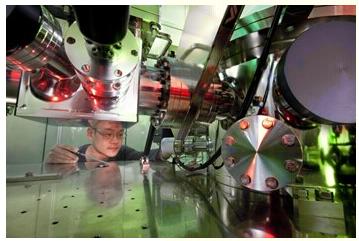
A Bolometer Camera developed at JET. Photo courtesy:K McKormick (IPP,Garching), A Huber (FZK)
Because of the harsh environment inside the Vacuum Vessel, these systems will have to cope with a range of phenomena not previously encountered in diagnostic implementation, while all the while performing with great accuracy and precision. The levels of neutral particle flux, neutron flux and fluence will be respectively about 5, 10 and 10,000 times higher than the harshest experienced in today's machines. The pulse length of the fusion reaction - or the amount of time the reaction is sustained - will be about 100 times longer.
Thursday, November 3, 2011
Reaktor Fusi
Reaktor Fusi
Vacuum Vessel
 The large stainless steel Vacuum Vessel provides an enclosed, vacuum environment for the fusion reaction. |

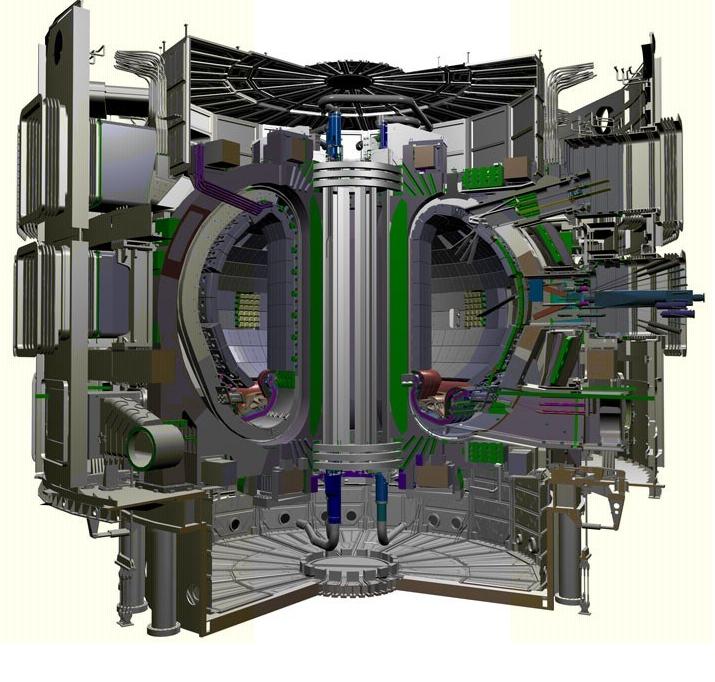
A cut-away of the ITER Vacuum Vessel showing the Blanket modules attached to its inner wall and the Divertor at the bottom.
The size of the Vacuum Vessel dictates the volume of the fusion plasma; the larger the vessel, the greater the amount of power that can be produced. The ITER Vacuum Vessel will be twice as large and sixteen times as heavy as any previous tokamak, with an internal diametre of 6 metres. It will measure a little over 19 metres across by 11 metres high, and weigh in excess of 5000 tons.

The ITER Vacuum Vessel with its 44 ports. At 8000 tons, the stainless steel vacuum vessel weighs slightly more than the Eiffel Tower.
The Vacuum Vessel will
have double steel walls, with passages for Cooling Water to circulate between them. The inner surfaces of the Vessel will be covered with Blanket Modules that will provide shielding from the high-energy neutrons produced by the fusion reactions. Some of the Blanket Modules will also be used at later stages to test materials for Tritium Breeding concepts.
Forty-four ports will provide access to the Vacuum Vessel for Remote Handling operations, Diagnostic systems, Heating, and Vacuum systems: 18 upper ports, 17 equatorial ports, and 9 lower ports.
Sumber:
Web Resmi ITER
Sunday, October 2, 2011
Reaktor Fusi
Reaktor Fusi
Magnets
 The 48 elements of the ITER Magnet system will generate a magnetic field some 200 000 times higher than that of our Earth. |
The ITER Magnet System comprises 18 superconducting Toroidal Field and 6 Poloidal Field coils, a Central Solenoid, and a set of Correction coils that magnetically confine, shape and control the plasma inside the Vacuum Vessel. Additional coils will be implemented to mitigate Edge Localized Modes (ELMs), which are highly energetic outbursts near the plasma edge that, if left uncontrolled, cause the plasma to lose part of its energy.

Superconducting cable being spooled after production at ASIPP, Institute for Plasma Physics, Hefei, China. Photo: Peter Ginter
The power of the magnetic fields required to confine the plasma in the ITER Vacuum Vessel is extreme. For maximum efficiency and to limit energy consumption, ITER uses superconducting magnets that lose their resistance when cooled down to very low temperatures. The Toroidal and Poloidal Field coils lie between the Vacuum Vessel and the Cryostat, where they are cooled and shielded from the heat generating neutrons of the fusion reaction.
The superconducting material for both the Central Solenoid and the Toroidal Field coils is designed to achieve operation at high magnetic field (13 Tesla), and is a special alloy made of Niobium and Tin (Nb3Sn). The Poloidal Field coils and the Correction coils use a different, Niobium-Titanium (NbTi) alloy. In order to achieve superconductivity, all coils are cooled with supercritical Helium in the range of 4 Kelvin (-269°C). Superconductivity offers an attractive ratio of power consumption to cost for the long plasma pulses envisaged for the ITER machine.
Toroidal Field System

One of the 18 Toroidal Field coils.
The 18 Toroidal Field (TF) magnets produce a magnetic field around the torus, whose primary function is to confine the plasma particles. The ITER TF coils are designed to have a total magnetic energy of 41 gigajoules and a maximum magnetic field of 11.8 tesla. The coils will weigh 6540 tons total; besides the Vacuum Vessel, they are the biggest components of the ITER machine.
The coils will be made of Cable-In-Conduit superconductors, in which a bundle of superconducting strands is cabled together and cooled by flowing Helium, and contained in a structural jacket. The strands necessary for the ITER TF coils have a total length of 150.000 kilometres and would span the earth more than three times.
Poloidal Field System

The Poloidal Field coil system consists of six independent coils placed outside the Toroidal Magnet structure.
The Poloidal Field (PF) magnets pinch the plasma away from the walls and contribute in this way to maintaining the plasma's shape and stability. The PF field is induced both by the Magnets and by the current drive in the plasma itself.
The Poloidal Field coil system consists of six horizontal coils placed outside the Toroidal Magnet structure. Due to their size, the actual winding of five of the six PF coils will take place in a dedicated, 250-metre long coil winding building on the ITER site in Cadarache. The smallest of the PF coils will be manufactured offsite and delivered finished.
The ITER PF coils are also made of Cable-in-Conduit conductors. Two different types of strands are used according to operating requirements, each displaying differences in high-current and high-temperature behaviour.
Central Solenoid

The Central Solenoid - the backbone of the Magnet system - is essentially a large transformer.
The main plasma current is induced by the changing current in the Central Solenoid which is essentially a large transformer, and the 'backbone' of the Magnet System. It contributes to the inductive flux that drives the plasma, to the shaping of the field lines in the Divertor region, and to vertical stability control. The Central Solenoid is made of six independent coil packs that use a Niobium-Tin (Nb3Sn) Cable-in-Conduit superconducting conductor, held together by a vertical precompression structure. This design enables ITER to access a wide operating window of plasma parameters, enabling the testing of different operating scenarios up to 17 MA and covering inductive and non-inductive operation.
Each coil is based on a stack of multiple pancake winding units that minimizes joints. A glass-polyimide electrical insulation, impregnated with epoxy resin, gives a high voltage operating capability, tested up to 29 kV. The conductor jacket material has to resist the large electromagnetic forces arising during operation and be able to demonstrate good fatigue behaviour. The conductor will be produced in unit lengths up to 910 metres.
Sumber:
Web Resmi ITER
Thursday, September 1, 2011
Reaktor Fusi
Reaktor Fusi
Cryostat

The entire Vacuum Vessel is enclosed within a Cryostat, or cold box, which provides insulation for the superconducting Magnet system and other components. |

The ITER Cryostat will be 31 metres tall and nearly 37 metres wide.
The Cryostat has many openings, some as large as four metres in diametre, which provide access to the Vacuum Vessel for Cooling systems, Magnet feeders, auxiliary Heating, Diagnostics, and the removal of Blanket and Divertor parts. Large bellows are used between the Cryostat and the Vacuum Vessel to allow for thermal contraction and expansion in the structures. The Cryostat is completely surrounded by a concrete layer known as the bioshield. Above the Cryostat, the bioshield is two metres thick.
Sumber:
Web Resmi ITER
Sumber:
Web Resmi ITER
Friday, October 1, 2010
Reaktor Fusi
Reaktor Fusi
External Heating Systems
  The ITER Tokamak will rely on three sources of external heating to bring the plasma to the temperature necessary for fusion. |
The temperatures inside the ITER Tokamak must reach 150 million° Celsius — or ten times the temperature at the core of the Sun — in order for the gas in the vacuum chamber to reach the plasma state and for the fusion reaction to occur. The hot plasma must then be sustained at these extreme temperatures in a controlled way in order to extract energy.

A Neutral Beam Injector and two types of high-frequency electromagnetic waves will help bring the plasma to temperatures exceeding 150 million°C.
Ultimately, researchers hope to achieve a "burning plasma" — one in which the energy of the Helium nuclei produced by the fusion reaction is enough to maintain the temperature of the plasma. The external heating can then be strongly reduced or switched off altogether. A burning plasma in which at least 50 percent of the energy needed to drive the fusion reaction is generated internally is an essential step to reaching the goal of fusion power generation.
Neutral Beam Injection Using injection to heat the fuel in the ITER Tokamak is very much like using steam in the household cappuccino machine to heat milk. Neutral Beam Injectors are used to shoot uncharged high-energy particles into the plasma where, by way of collision, they transfer their energy to the plasma particles.
Before injection, Deuterium atoms must be accelerated outside of the Tokamak to a kinetic energy of 1 Mega electron Volt (MeV). Only atoms with a positive or a negative charge can be accelerated by electric field; for this, electrons must be removed from neutral atoms to create a positively-charged ion. The process must then be reversed before injection into the fusion plasma; otherwise the electrically-charged ion would be deflected by the magnetic field of the plasma cage. In Neutral Beam Injection systems, the ions pass through a cell containing gas where they recover their missing electron and can be injected as fast neutrals into the plasma.

It's all about kinetic energy - the Neutral Beam Injector accelerates fast neutralized Deuterium particles into the plasma.
Two Neutral Beam Injectors are currently foreseen for ITER. A third Neutral Beam will be used for diagnostic purposes.
Ion Cyclotron Heating 
The ITER Ion Cyclotron antennae will look a lot like these being installed at JET in the UK. Photo: JET
Ion and Electron Cyclotron heating methods use radio waves at different frequencies to bring additional heat to the plasma, much in the same way that a microwave oven transfers heat to food through microwaves. In Ion Cyclotron Resonance Heating (ICRH), energy is transferred to the ions in the plasma by a high-intensity beam of electromagnetic radiation with a frequency of 30 to 50MHz.
A generator, transmission lines and an antenna are necessary for Ion Cyclotron heating. A generator produces high-power radio frequency waves that are carried along a transmission line to an antenna located in the Vacuum Vessel, sending the waves into the plasma.
Electron Cyclotron Heating Electron Cyclotron Resonance Heating (ECRH) heats the electrons in the plasma with a high-intensity beam of electromagnetic radiation at a frequency of 100 to 200MHz; the resonant frequency of electrons. The electrons in turn transfer the absorbed energy to the ions by collision.
The Electron Cyclotron heating system is also used to deposit heat in very specific places in the plasma, as a mechanism to minimize the build-up of certain instabilities that lead to cooling of the plasma. In comparison to the ICRH system, the ECRH has the advantage that the beam can be transmitted through air which simplifies the design and allows the source to be far from the plasma, simplifying maintenance. Power will be provided by powerful, high-frequency gyrotrons as power sources. The ITER design includes the development of a 1 MW gyrotron operating at 170 GHz with a pulse duration of more than 500 s.
Sumber:
Web Resmi ITER
Tuesday, June 1, 2010
Reaktor Fusi
Reaktor Fusi
The ITER Divertor


The Divertor is one of the key components of the ITER machine. Situated along the bottom of the Vacuum Vessel, its function is to extract heat and Helium ash — both products of the fusion reaction — and other impurities from the plasma, in effect acting like a giant exhaust system. It will comprise two main parts: a supporting structure made primarily from stainless steel, and the plasma-facing components, weighing about 700 tons. The plasma-facing components will be made of Tungsten, a high-refractory material. |

The three plasma-facing components of the ITER Divertor: the inner and the outer vertical targets, and the dome.
ITER will begin operations with a Carbon fibre-reinforced Carbon composite (CFC) Divertor target. This material presents the advantage of high thermal conductivity and it enables an easier learning process for the first years of ITER operation. A second Divertor set will be made of Tungsten which has the advantage of a lower rate of erosion and thus a longer lifetime.
Subscribe to:
Posts (Atom)